Here in Catalunya the tradition of cheese had been lost. At the end of the 70s and beginning of the 80s the hippies left the cities for rural areas and masias (isolated farmhouses) and amongst the things they began to do was make cheese. Some of the people who worked the fields, like myself, got caught up in it. (Story Toni Chueca told me)
There were some technicians or schools that gave courses in cheese. One of the consultants was Ramon and he had an apprentice, Enric Canut.
Some hippies began to make goat cheese in a town in the province of Garrotxa, Sant Miguel de Campmayor. They were advised by Ramon and Enric. They asked a grandmother in town how she made cheese and they copied her. I think it as a pasteurized goat cheese, enzymatic but that let the cheese cultures work a lot to become acidic. The cut of the curd was soft not working it too much so that it would stay moist and acidic.
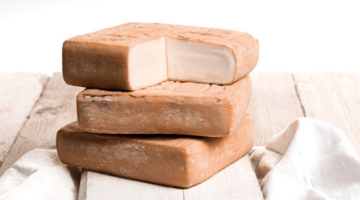
The result is a cheese that aged around 3 weeks, no more and they sold it at local markets. As the climate in Garrotxa is humid and the cheese acidic, cheese grew on the rind and they left it there, I don’t know if Grandma’s original cheese had the mold as well.
The cheese has changed during the years becoming firmer, and easier to travel. Originally it was too humid and I believe we all started to work the curd harder in the vat to get a drier cheese that would hold up better. A harder curd doesn’t acidify as much. Aging hasn’t changed much over the years.
A few years ago as a first step to equalize criteria for a future IGP, Enric did a course how the first Garrotxa was. I went – we all did, and that cheese was good and all but it couldn’t hold up on a trip to the U.S. Then after the course we did a blind tasting and Enric judged without knowing whose was whose and MINE WAS THE BEST. My mom and Enric never were friends as he was not her consultant and I think even he was super surprised.
One time you asked me why my cheese is different. The truth is that I don’t consider myself an amazing cheesemaker but I have very clear in my mind a few things: Firs – the milk. We collect it directly from just a few farmers. We know the goats, what they eat, and how old the milk is that we use. Another important point is the work in the Vat. We always have liked to work the curd more so that it has less water. We get a lower yield but a cheese that is much more stable and better to travel. Another pont is a lot of love in the aging rooms. We are the only ones that age on shelves as opposed to in plastic cases so the cheese has better ventilation and it ages better. We also try to let the mold do its thing and go its course until the cheese is sold (2 months) If you sell the cheese before then the mold hasn’t finished and it grows out of control within the crates. Our cheese we have achieved a great balance.
The name of Garrotxa started to be used by Mogent, a dairy partner of the Consorzio of Maestros Queseros, the first to export to the US. They made the cheese known as a traditional one of Catalunya and then we made it more well known. It has always been the same cheese but it became famous in the US before here! Curious, no?
Sorry for the long drawn out answer. The truth is that back then I was just a kid and this information you could get better from Toni Chueca that lived it in first person. He is one of the original hippies and his cheese is more like the original version than mine as it is more moist and soft.